
Don't Panic
Happy Towel Day. On Douglas Adams, the answer being 42, and why "Don't Panic" is the best leadership advice ever written.

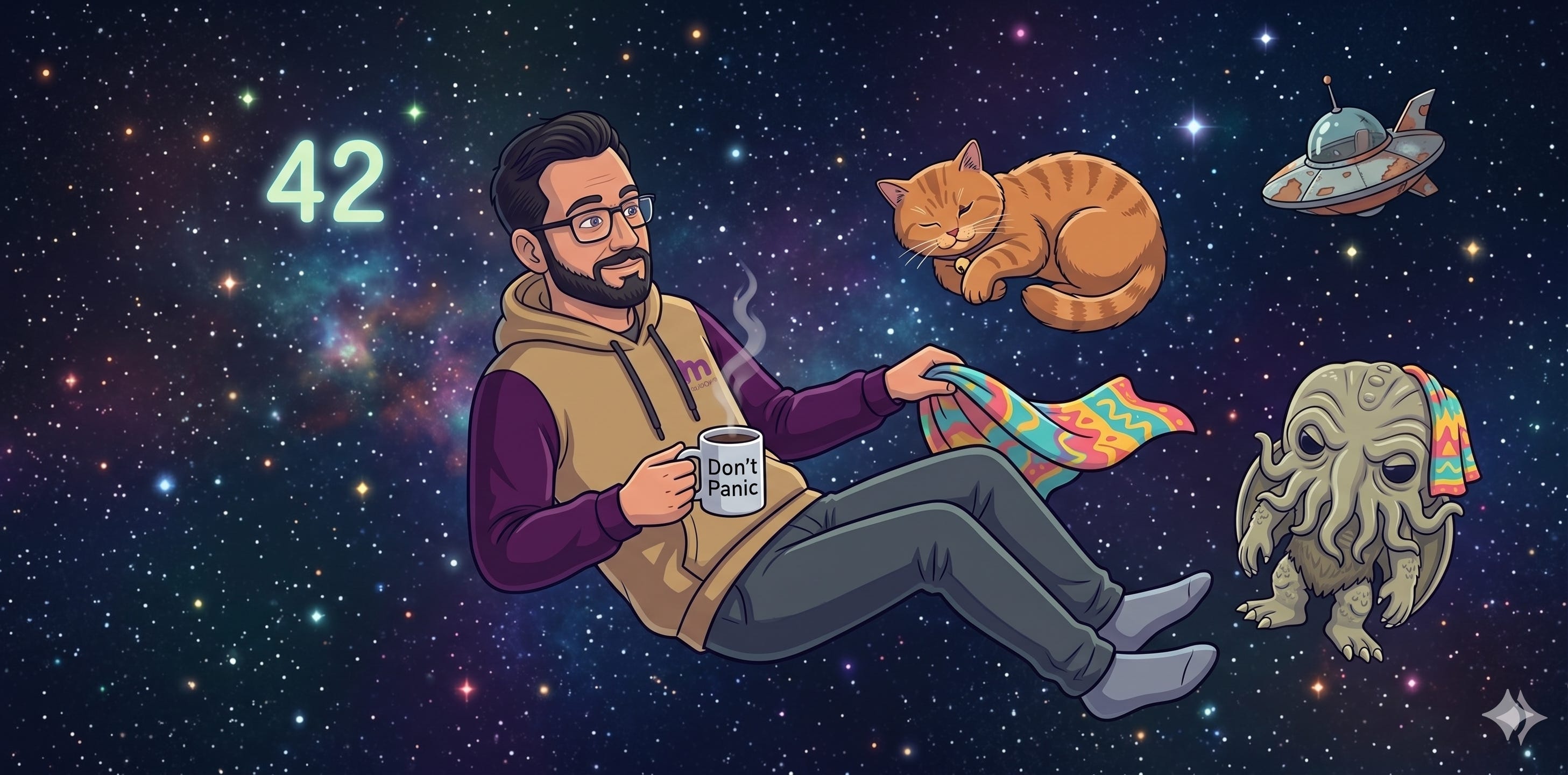
Today is Towel Day. The annual celebration of Douglas Adams, author of The Hitchhiker’s Guide to the Galaxy, who died in 2001 and left behind what might be the most accurate description of the modern technology industry ever written… despite the fact that he wrote it in 1979.
If you’re not familiar with the Guide, here is what you need to know: it’s a book about a man named Arthur Dent who survives the destruction of Earth, scheduled to make way for a hyperspace bypass, after the proper paperwork had been filed and then spends the rest of his life trying to figure out what’s going on. The Guide itself, which is described as being “slightly” less accurate than other encyclopedias but considerably cheaper, carries on its cover the most important two words in the universe:
Don’t Panic.
The Answer Was 42. We Forgot to Write Down the Question.
The central joke of Hitchhiker’s, and it’s a joke that gets more serious the longer you sit with it, is that a civilization builds an enormous supercomputer called Deep Thought and runs it for seven and a half million years to find the Answer to Life, the Universe, and Everything.
The answer is 42.
The problem, as Deep Thought patiently explains, is that nobody wrote down the original question. The Answer is correct. It’s just useless without knowing what was being asked.
So Deep Thought designs a second computer to find the question. That computer is the Earth. A planet-sized organic computer, running for millions of years, populated by beings who have no idea they are part of the programme.
Which means we, all of us, are the computer built to find the question.
I want you to think about that for a moment in the context of AI in 2026.
We have built systems of extraordinary capability. Systems that can write, reason, code, translate, summarize, diagnose, and generate at a speed and scale that would have seemed like science fiction when Adams was writing. The answers these systems produce are, in many cases, genuinely remarkable.
But we’re still figuring out the questions.
Not the technical questions, those are getting solved faster than anyone expected. The human questions. What do we actually want this for? What does “better” look like? Whose definition of helpful are we optimizing toward? What are we willing to give up, and what are we not?
The Answer is 42. We are the computer that still needs to find the question.
What Adams Actually Understood About Technology
Adams was writing satire, but he was also writing from inside a specific moment: the early days of personal computing, when technology was beginning to feel genuinely strange and genuinely powerful, and nobody was quite sure what the rules were yet.
What he understood, which most technology writing of that era missed entirely, is that the most interesting problems created by powerful technology are not technical problems. They’re bureaucratic problems, communication problems, coordination problems and, above all, problems of meaning. What is this for? Who is it for? What does it mean for how we live?
The most memorable illustration of this in the whole book isn’t Deep Thought, or the planning notice to destroy the Earth, or even the restaurant at the end of the universe. It’s a whale and a bowl of petunias, falling.
The Infinite Improbability Drive transforms a missile into a sperm whale, which suddenly finds itself alive, high above the surface of a planet, with just enough time during the fall to discover the world, develop opinions about it, and wonder, quite sincerely, what all this is.
Next to it falls a bowl of petunias, which has only time to think: “Oh no, not again.”
Adams adds, almost as an aside, that if we could understand the significance of that “not again,” we would have a much clearer idea of the nature of the universe.
I find this enormously useful when thinking about technology. Every major wave of change produces both: the whale, discovering everything at speed, exhilarated and slightly confused, and the bowl of petunias, which has been here before and knows exactly how this ends. The best organizations have both. The trick is knowing which one you are at any given moment.
The Three Things the Guide Gets Right About Leadership
Bring your towel. The towel, Adams explains, is the most useful thing an interstellar traveler can carry, not because of its practical applications, but because anyone who can keep track of their towel under the circumstances of interstellar travel is clearly a person who has it together. The symbolism is obvious once you see it: the towel is preparedness, resourcefulness, and the refusal to be caught completely unprepared. You don’t need to have all the answers. You need to have your towel.
The best decisions are made with imperfect information, under pressure, in slightly absurd circumstances. Arthur Dent makes almost no good decisions in the traditional sense. He reacts. He adapts. He manages, mostly, not to make things catastrophically worse, which in the circumstances is genuinely impressive. This is also, if we’re honest, most of what leadership looks like in practice: not brilliant strategic foresight, but coherent navigation of situations that nobody fully anticipated.
Don’t mistake the improbability drive for a strategy. The Heart of Gold, the spaceship at the center of the story, runs on an Infinite Improbability Drive, which generates solutions by passing through every improbable state simultaneously. It works. But nobody is quite sure what it will do next, it frequently turns things into sofas, and using it as your primary navigation system is not recommended.
Most of us have worked with people who ran their leadership on the equivalent of an improbability drive. You might agree, the results were occasionally spectacular and generally exhausting for everyone involved.
Don’t Panic. Seriously.
My book has a chapter called “Don’t Panic.” I wrote it because I think it’s the most underrated instruction in a world that has developed a significant financial interest in keeping people in a state of continuous mild alarm about technology.
The AI isn’t coming to destroy you. The geopolitics of AI platforms are genuinely complex but not unnavigable. The pace of change is real but it’s not faster than human beings can process if they stop trying to process all of it at once.
Know what your tools are for. Know who built them and what they believe. Know what you’re not willing to compromise on, and protect that. Design your feedback systems so they tell you what’s true, not just what’s comfortable, because the default, as I wrote earlier this month, is always accommodation. Update your thinking when the evidence changes. Keep your towel close.
The universe is, as Adams correctly identified, mostly harmless.
Happy Towel Day.
What’s the best piece of advice from unexpected places: a novel, a film, a song, that you’ve actually applied to how you work? I’m curious.
Reply here or find me on LinkedIn. And if you haven’t read Hitchhiker’s, do yourself a favour this weekend.