
Leaders Are Breaking. We Keep Blaming the Wrong Thing.
Burnout is back at record levels. But for the first time, the main driver isn't workload

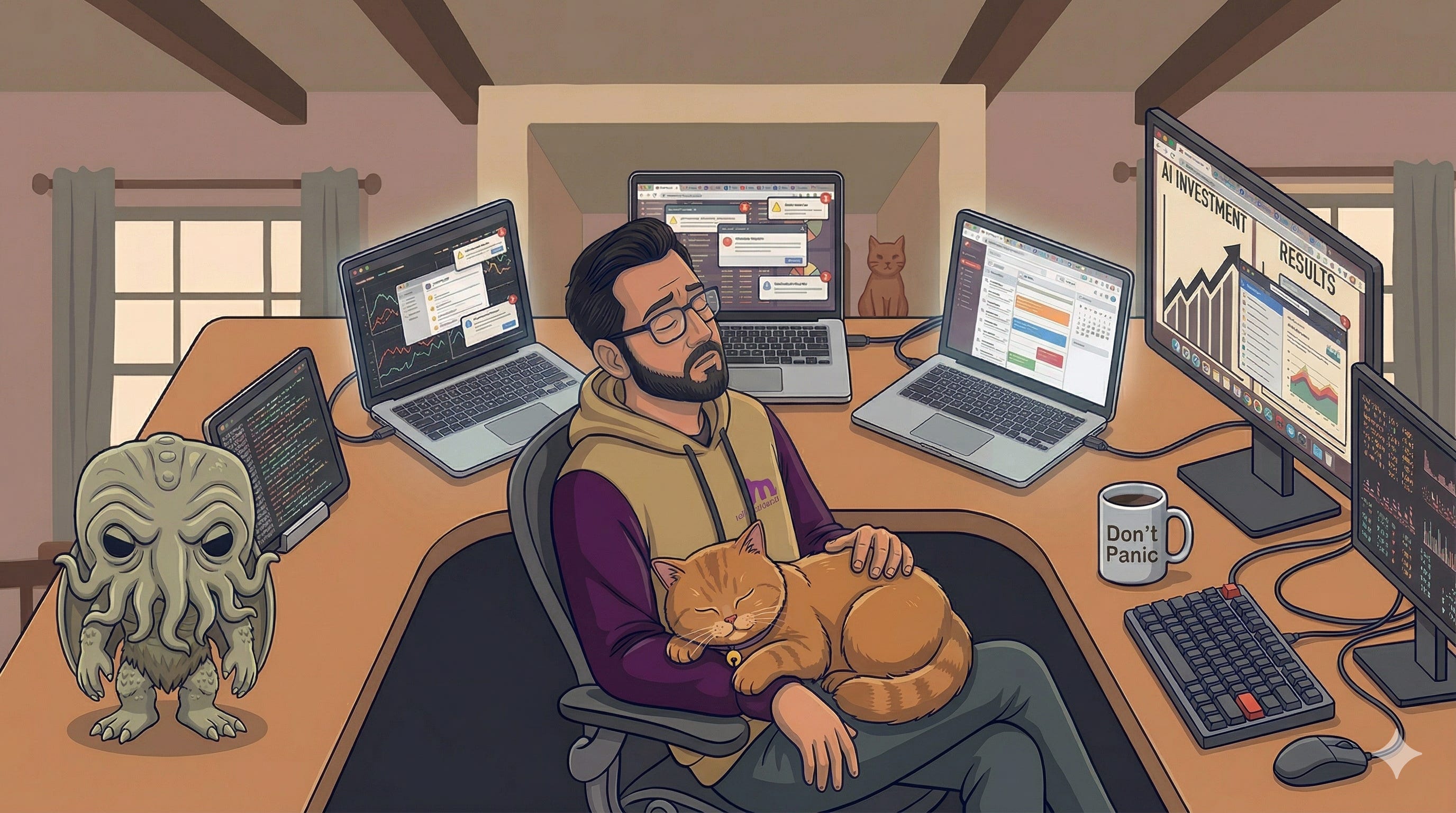
I nearly missed it myself.
A while back, I went through a period where I felt genuinely exhausted, in the specific way that is hard to explain to people who have not experienced it. Not tired. Not stressed in the ordinary sense. More like a kind of cognitive static, a background noise that made everything slightly harder than it should have been. Decisions that should have been straightforward required more effort than usual. Conversations I normally enjoyed started to feel like obligations.
I looked at my workload and it was not, objectively, worse than it had been in other periods. That was the part that confused me most. I kept waiting to find the thing I could remove, the commitment I could drop, the meeting I could cancel.
It took me longer than I would like to admit to understand what was actually happening.
The New Shape of Burnout
For years, the conversation around burnout has been almost entirely about volume. Too many hours, too many responsibilities, too many demands competing for too little time. That framing has produced an entire industry of solutions: boundaries, delegation frameworks, time management systems, the right to disconnect.
Most of those solutions address real problems. But new research suggests that the dominant driver of burnout has shifted, and the old solutions are increasingly being applied to the wrong diagnosis.
Deloitte’s 2025 Workforce Intelligence Report identified something new: for the first time, mental fatigue, cognitive strain, and what they call decision friction have surpassed workload volume as the leading indicators of burnout. Not how much you are doing. How many times your brain is forced to switch contexts, make micro-decisions, absorb partial information, and adapt to change, all without ever reaching a state of completion.
Microsoft’s 2025 Work Trend Index reported a 42% increase in what it describes as digital overwhelm, not from doing more work, but from navigating more fragmented, interrupted, and context-dependent work.
This distinction matters more than it might initially appear. Because the response to cognitive overload is fundamentally different from the response to excess workload. You cannot solve it by doing less. You have to solve it by thinking differently about how work is structured.
The Specific Problem for Leaders
The burnout numbers in leadership roles are striking on their own. DDI’s Global Leadership Forecast found that roughly 4 in 10 stressed leaders have seriously considered leaving their leadership roles entirely to protect their wellbeing. Gallup’s 2025 research found that managers account for up to 70% of the variance in team engagement and wellbeing, yet many of those same managers are themselves operating in conditions that would qualify as chronic stress.
There is a particular irony in the data. The leaders most likely to recognize and address burnout in their teams are the ones most likely to be experiencing it themselves and least likely to acknowledge it.
I have written about this before: the “jolly” syndrome, the leader who becomes the universal problem solver, the person who fills every gap, who holds everything together precisely because they cannot bring themselves to let anything fall. That pattern does not come from bad intentions. It comes from a deep-seated belief that leadership means being the last line of defense, always.
But there is a structural dimension to this that is new, and it has arrived with the current moment in technology. The pressure to navigate AI transformation, to form a position on every new tool, to stay current on a landscape that changes weekly, to answer the question “what are we doing about AI” in every stakeholder conversation, has added a specific cognitive load on top of everything else. It is not more work in the traditional sense. It is more ambiguity, more decisions made with insufficient information, more adaptation required before the previous adaptation has settled.
That is a different kind of exhausting.
What Sustainable Leadership Actually Looks Like
The OECD’s 2025 Skills Outlook found that nearly 30% of job roles in advanced economies are now structurally mismatched with the realities of digital and AI-enabled work. Outdated role definitions and unclear responsibilities are becoming significant burnout drivers in their own right. People are being asked to perform jobs that have changed substantially without the job description, the tools, or the support structure catching up.
For leaders, this creates a specific responsibility that is easy to overlook when you are inside it: the system you are operating within may itself be generating the cognitive load, not the individual tasks within it. Fixing it requires stepping outside the operational pressure long enough to look at the architecture of how work actually flows, where decisions pile up, where context constantly gets switched, where people are perpetually interrupted before they can finish anything.
That kind of structural thinking requires exactly the state of mind that chronic cognitive overload makes hardest to access. Which is, of course, the trap.
I keep returning to something I have believed for a long time and find confirmed regularly in practice: a leader who cannot model their own boundaries cannot build an organization where boundaries are real. Not because of what they say, but because of what their presence communicates about what is actually expected.
If everything is always urgent for the person at the top, then everything will always feel urgent everywhere below them. Not because it is. Because the signal from above sets the baseline for what normal looks like.
The most important thing many leaders could do right now has nothing to do with productivity systems or time management techniques. It is to get honest about what the structure of their work is actually doing to their capacity to think, and to treat that honestly as a leadership problem rather than a personal failing.
Burnout at the top cascades. The research on this is consistent and unambiguous. And the new form it is taking, quiet, cognitive, driven by fragmentation rather than volume, is precisely the kind that is hardest to see until it has already done its damage.