
The 70% Number Hides the Real Question
The data is loud about how often transformations fail. Quiet about who decided to start them.

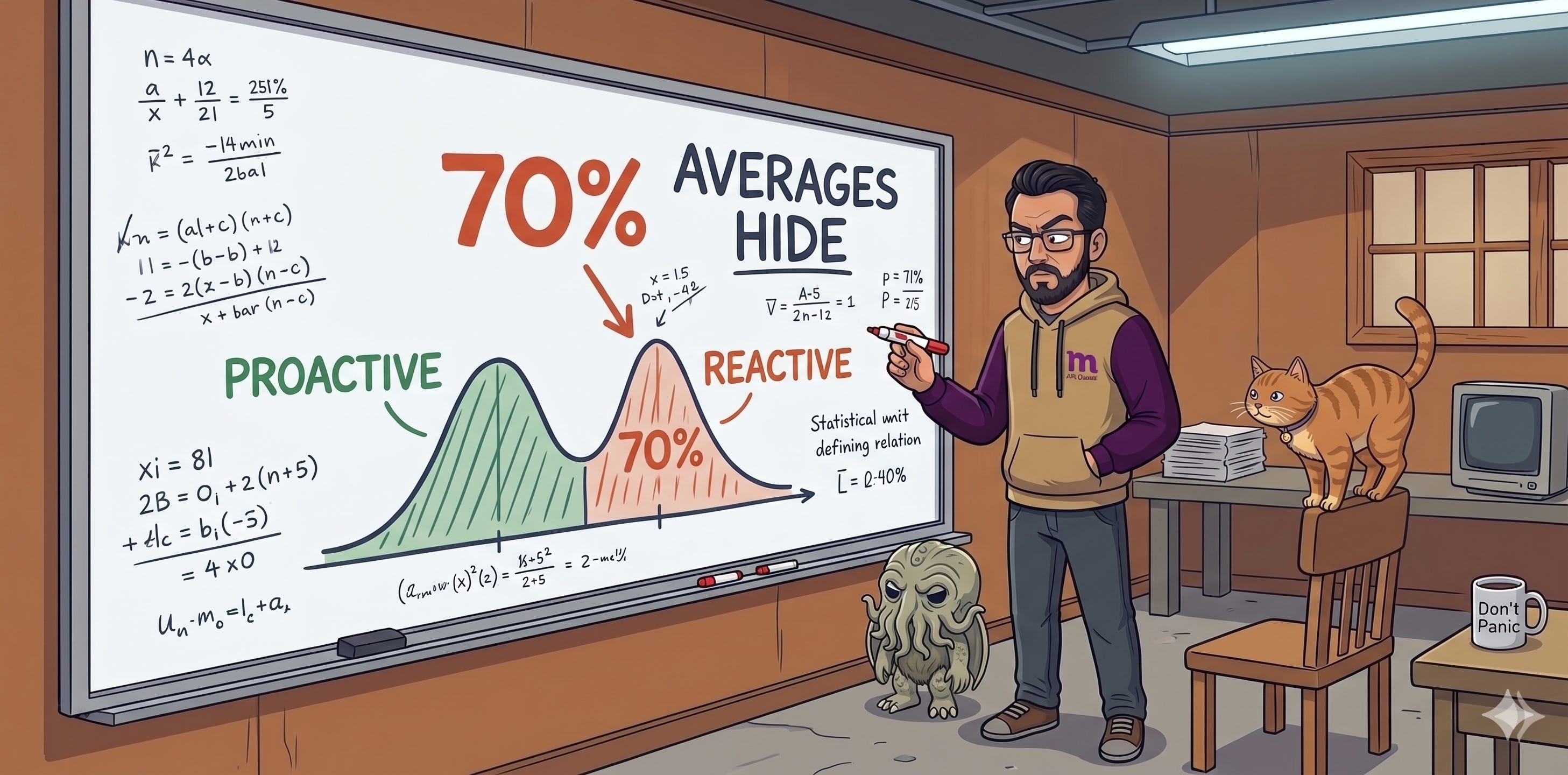
There is a number every transformation deck cites. Most CEOs can quote it without checking. Around 70% of transformations fail. The number has been around for fifteen years, give or take.
It’s the kind of statistic that has earned the right to be repeated without a footnote. Try to find a board presentation on change management that doesn’t reference it. You won’t.
I want to ask a quieter question. One that doesn’t show up on the slides.
70% of what, exactly?
What the studies measure, and what they don’t
The 70% claim has a few sources. The most cited is John Kotter’s Leading Change, which argued, back in the mid-1990s, that the majority of change efforts fail. McKinsey has published variations on the same theme through repeated transformation surveys over the past fifteen years. BCG and Bain have run their own. The numbers move a little. The order of magnitude doesn’t.
I’m not here to argue with the studies. They measure what they say they measure. The question is what they don’t measure, and what gets quietly lost when an audience reads the headline.
In most of these surveys, “failure” means roughly the same thing: the transformation did not achieve its stated objectives, or did not deliver the expected return. Honest definitions. Loose enough to cover a lot.
Here is what gets pooled into the same 70%. Banks transforming after the 2008 regulatory wave. Pharma companies transforming under pandemic pressure. Retailers transforming because Amazon happened to them. Mid-market manufacturers transforming through the 2018–2022 digital pivot. All of these get counted together, as if starting a transformation were a homogeneous act, as if the leader who saw a market shift and named it, and the leader who was handed the name after a quarterly miss, were doing the same thing.
They are not.
Two cohorts, not one
The 70% number is an average, and like all averages over heterogeneous populations, it hides.
Run the segmentation yourself. Take the same dataset, however informally, and split it not by industry, not by size, not by region but by initiating posture. Two cohorts.
The first cohort: transformations started because a leader saw a shift, named it, built the case, and convinced the rest of the room. Proactive. Decision-led. The leader owns the why before owning the how.
The second cohort: transformations started because the leader had to. The board demanded a response after a quarterly miss. A regulator forced the hand. A competitor moved first and made the inaction untenable. Reactive. Pressure-led. The leader is staffing a response, not authoring a decision.
These two cohorts do not fail at the same rate.
I cannot give you a peer-reviewed split, the underlying studies don’t segment this way. But from my experience working alongside mid-market leadership teams: the proactive cohort fails substantially less often than the headline number. The reactive cohort fails substantially more. The 70% is the average of two very different populations.
Take electronics retail in the late 2000s. Best Buy and Circuit City both faced the same Amazon-shaped pressure. Comparable scale, overlapping product lines, similar margins under attack.
Each ran a “transformation.” Circuit City, in fact, ran two. The first, in the years before 2008, was a cost-cutting exercise, including firing thousands of experienced sales staff in 2007 to bring in lower-paid replacements. The company filed for bankruptcy that November. The second “transformation” came in 2015, when a different owner bought the Circuit City name and rebuilt it as an online-only retailer. The 1949 company didn’t transform itself; it liquidated. A different company later started up under its name.
Best Buy, under Hubert Joly from 2012, ran a different kind of transformation: “Renew Blue”; choosing to reinvest in stores, retrain staff, and turn the physical network into a competitive asset against Amazon. Same company before and after. Same workforce, sharpened.
Both companies, on paper, had run transformations through the same decade. Both would have been counted in the same surveys. Best Buy is still operating today. The Circuit City of 2008 is not.
Three questions, five minutes
So how do you know which cohort you’re in?
There are three questions you can ask yourself, alone, this week. They take five minutes and they do not require a consultant.
The first: did I name this transformation, or did someone hand me the name? If you can trace the original framing back to your own observation of the market, you’re closer to the proactive cohort. If the framing arrived in a board memo, a regulator’s letter, or a competitor’s quarterly results, you’re closer to the reactive cohort.
The second: could I write the why in one paragraph without referencing a competitor, a regulator, or a quarterly miss? Try it. If the paragraph holds up as a statement of intention rather than a reaction, you’re in the proactive cohort. If you can’t get past three sentences without naming an external pressure, you’re not.
The third is the one that costs something, because the words alone won’t answer it. When asked “why now,” where does the urgency come from? A leader with long-range vision says “we have to” and means it, the imperative lives inside their forecast, their conviction, their read of the moment. A reactive leader says “we have to” too, but the imperative lives outside, in a board memo, a competitor’s move, a regulator’s letter, a missed quarter. Same words; different source. The test is the source, not the phrasing.
The answers, in practice, sit on a spectrum, not a binary. A transformation that started fully reactive can be reframed by a leader who decides, mid-stream, to take ownership of it. Conversely, a proactive transformation can drift into reactive territory the moment the leader stops choosing.
The diagnostic isn’t where you started. It’s where you are now.
Last week I argued that the verb tense a leader uses to describe change is a confession. This week, I’d add: the aggregate data agrees, once you ask what the average is hiding.
Most leaders, reading the 70% number, jump to how do I get into the 30%. It’s fair, they are right, because it’s the question that makes you feel responsible. But they miss the harder one: which cohort did I start in: the one that chose, or the one that was chosen for. It tells you whether the responsibility is real.
If this resonated, forward it to someone who quoted the 70% number to you in the last six months.