
The Grammar of Avoided Decisions
How a CEO talks about change. The verb tense will tell you what they actually decided.

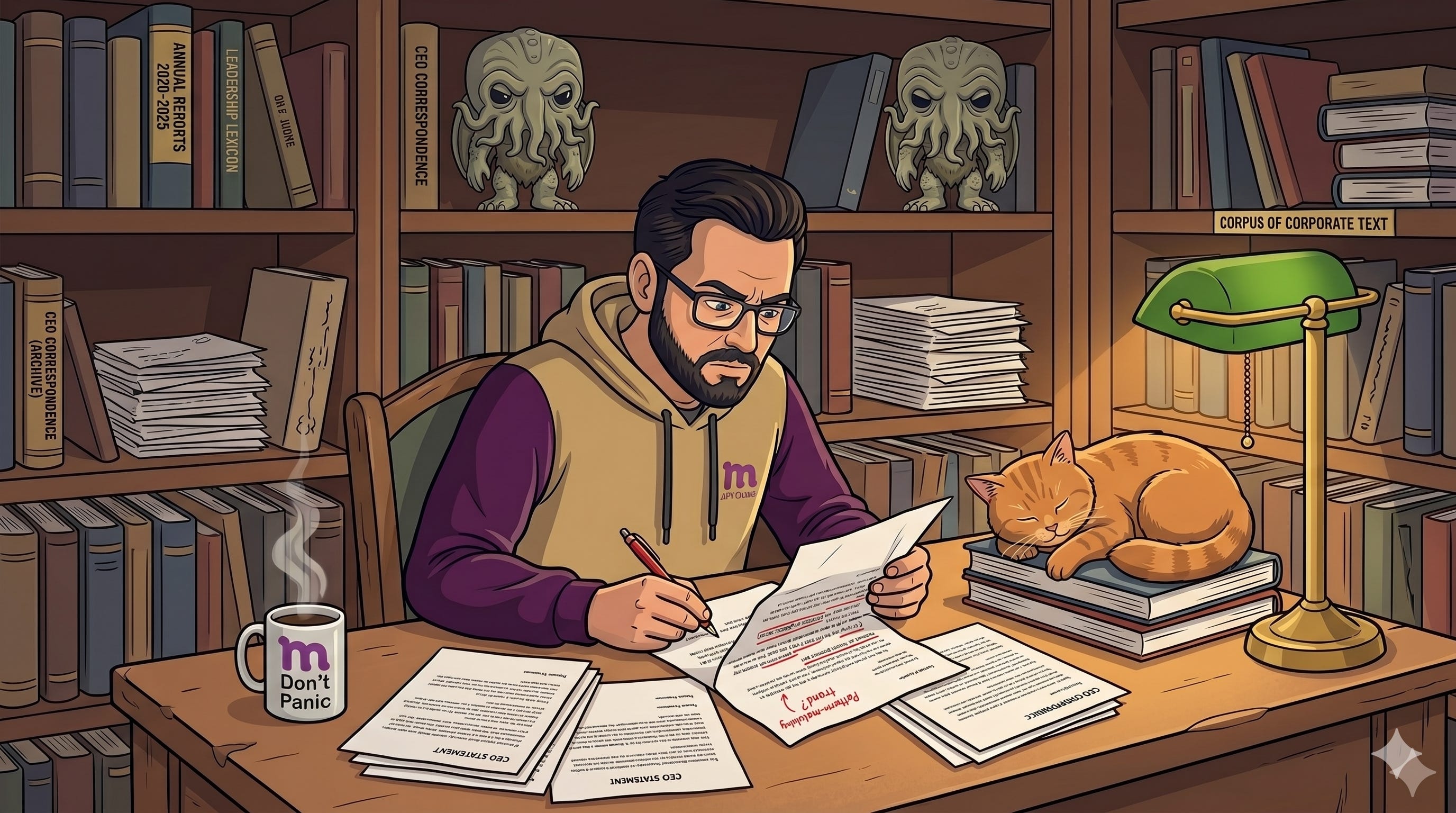
Last quarter I read a bunch of CEO letters in a row. Not because the strategy in them was particularly interesting, but because I had a hunch about something I couldn’t yet name. By the third letter, I had noticed it. By the seventh, I was counting.
It wasn’t what they said. It was how.
There is a sentence, in some version, with some variation, in roughly all of them. It goes like this: “We were caught off guard by the pace of change.”
Were caught.
Not “we did not move.” Not “we waited too long.” Not “I missed it.”
Were caught.
The grammar of disruption
Once you start hearing it, you can’t stop. The dominant grammar of business is structurally passive. Companies get disrupted. Markets shift. Technologies appear. Pandemics arrive. AI happens. The press uses this grammar, Business schools use it and,of course, Boardrooms use it.
This is not innocent. It is the language of the witness, not the agent.
When Clayton Christensen introduced “disruption” in the 1990s, the word had a specific, almost technical meaning: a model for how new entrants attack incumbent business models from below. It was descriptive, not exonerating. Three decades later, the word lives a second life. It has been quietly nominalised into a force of nature. Disruption strikes. Disruption threatens. Disruption comes for an industry. The original observation has become a weather report.
I’m not making a writing-craft point. I’m making a leadership-posture point. The grammar a leader uses to describe change is not separated from the leader’s relationship to it. The grammar is the relationship.
If your strategy deck describes events that happened to you, and your leadership memo describes events that happened to you, and your all-hands narrative describes events that happened to you, well, that’s not a coincidence of style. That’s a posture, written down.
The verb tense is a confession
Here is what I’ve come to believe, after fifteen years of working with mid-market companies through three waves of digitisation: when a leader uses passive voice to describe a market shift, they are not analysing an event. They are confessing the posture they took toward it.
“We were disrupted by AI” is not a strategic claim. It is an admission. What it actually says, translated into honest grammar, is: “I was not the one making the choices that mattered.”
That admission is the article worth reading. Everything else is just decoration.
The companies I have seen come out of the last three digital waves stronger were not, on average, the ones with better tools, deeper budgets, or earlier signals. The market gave most of them roughly the same information at roughly the same time. The difference, almost every time, was who on the leadership side used active verbs.
Listen to the difference.
One leader says: “The market shifted. Our customers changed. AI happened.”
Another leader, in the same industry, in the same quarter, says: “We decided to wait. We chose tools first because change scared us. I missed it.”
Same wave. Different verbs. Different outcomes, every time.
The first leader sounds analytical. They are reporting weather. The second leader sounds vulnerable. They are reporting a decision. Most of us were trained to believe the first voice is the more competent one. It isn’t. It is the more comfortable one.
Comfort and competence are not the same thing, and the verb tense will tell you, in three seconds, which one is in the room.
A diagnostic, not a writing tip
So what do you do with this on a Monday?
First: don’t try to fix it by editing your prose. Cleaning up your sentences won’t fix the posture, because the prose is the readout, not the cause. A leader who rewrites their letter in active voice while still operating in a passive-voice posture has only managed to camouflage the diagnostic.
Instead, run the diagnostic honestly. Take your last three artifacts: an all-hands transcript, a board memo, a quarterly letter. Read them with one job: mark every sentence about change as active or passive. Count.
Three patterns will reveal themselves if they are there. Your strategy will talk about responding to things more than deciding things. Major shifts in your industry will be described in the third person, as events with no addressee. And, this is the one that hurts, you will catch yourself using “the team” or “the market” as the grammatical subject of sentences whose honest subject is I.
The ratio of active to passive constructions in your own communication is your leadership posture, written in your own hand. Not approximately. Exactly. It is one of the cleanest diagnostics I know, and one of the few I trust without further interpretation.
The verbs are not the symptom. The verbs are the X-ray.
The cycle of writing I’m starting this month rests on a single conviction: the mindset of change is a choice, not a consequence. The choice does not first show up in your strategy doc. It does not first show up in your vision statement. It first shows up in your verbs, in ordinary speech, in the language you use when you are not listening to yourself.
So listen this week. The next time you describe something happening in your industry, notice the verb. If it’s passive, you have your first data point.
The second one is harder: what would you say if you used an active verb?
If this resonated, forward it to someone whose verbs you’ve been wondering about.